


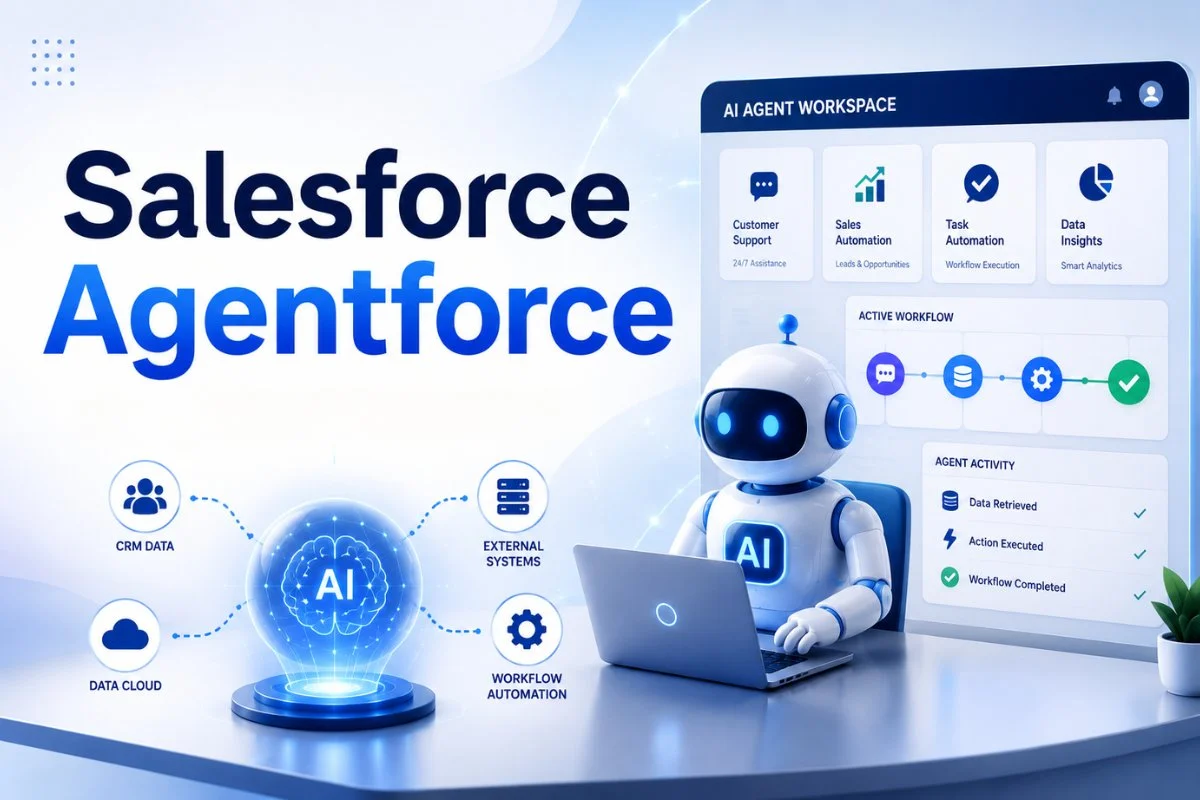
Salesforce is rapidly moving toward AI-powered automation, and one of the biggest innovations introduced recently is Agentforce. Instead of using traditional chatbots or simple automation tools, Agentforce helps businesses create intelligent AI agents that can understand requests, reason with data, take actions, and automate work across Salesforce.
From customer support and sales automation to internal operations and AI workflows, As a result Agentforce is becoming one of the most important technologies in the Salesforce ecosystem.
If you are a Salesforce Admin, Developer, Architect, or beginner exploring Salesforce AI, understanding Agentforce is now extremely important.
What Is Salesforce Agentforce?
Moreover, these AI agents can connect with workflows, APIs, and external systems.
Unlike traditional chatbots that only respond with scripted answers, Agentforce agents can:
- Understand user requests
- Analyze business context
- Retrieve Salesforce data
- Make decisions
- Trigger workflows
- Execute actions automatically
- Interact with external systems
These AI agents work like intelligent digital employees inside Salesforce.
Salesforce designed Agentforce to combine:
- AI reasoning
- Automation
- CRM data
- Workflows
- APIs
- Enterprise security
This allows organizations to automate complex tasks much more intelligently than older automation systems.
If you are new to Salesforce automation, reading salesforce flow for beginners and Apex Trigger Tutorial for Beginners in Salesforce in Salesforce will help you understand how automation works before learning AI agents.
Why Salesforce Agentforce Is Important
Traditional automation tools follow fixed rules.
For example:
- If status changes → send email
- If lead created → assign owner
- If case closed → update field
However, businesses now need smarter automation.
Meanwhile introduces AI-powered reasoning where agents can:
- Understand intent
- Analyze customer context
- Decide next actions
- Handle multi-step workflows
- Collaborate with humans
This moves Salesforce from rule-based automation toward intelligent AI-driven automation.
How Salesforce Agentforce Works
Salesforce Agentforce works using several core components together.
The overall flow looks like this:
- User sends request
- AI agent understands the request
- Atlas Reasoning Engine analyzes context
- Data Cloud retrieves business data
- Agent decides next action
- Workflow or API executes action
- Result is returned to the user

Core Components of Salesforce Agentforce
Understanding Agentforce becomes easier when you break it into components.
Agent Builder
Agent Builder is the interface used to create AI agents.
Admins and developers can configure:
- Agent behavior
- Topics
- Actions
- Integrations
- AI instructions
- Channels
Salesforce designed Agent Builder to support low-code AI development.
This means many AI agents can be created without heavy coding.
Topics in Agentforce
Topics define what an AI agent is allowed to handle.
Examples:
- Order management
- Customer support
- Lead qualification
- Account updates
- Case handling
Topics act as guardrails for AI agents.
Without assigned topics, the agent cannot perform related tasks.
This helps improve AI governance and security.
Actions in Agentforce
Actions define what the agent can actually do.
Actions may include:
- Running Salesforce Flows
- Executing Apex classes
- Calling APIs
- Querying Salesforce data
- Updating records
- Sending emails
Agentforce actions are commonly connected with Salesforce Flow and Apex automation.
If you are learning automation development, also read:
- Salesforce Developer Console Tutorial for Beginners
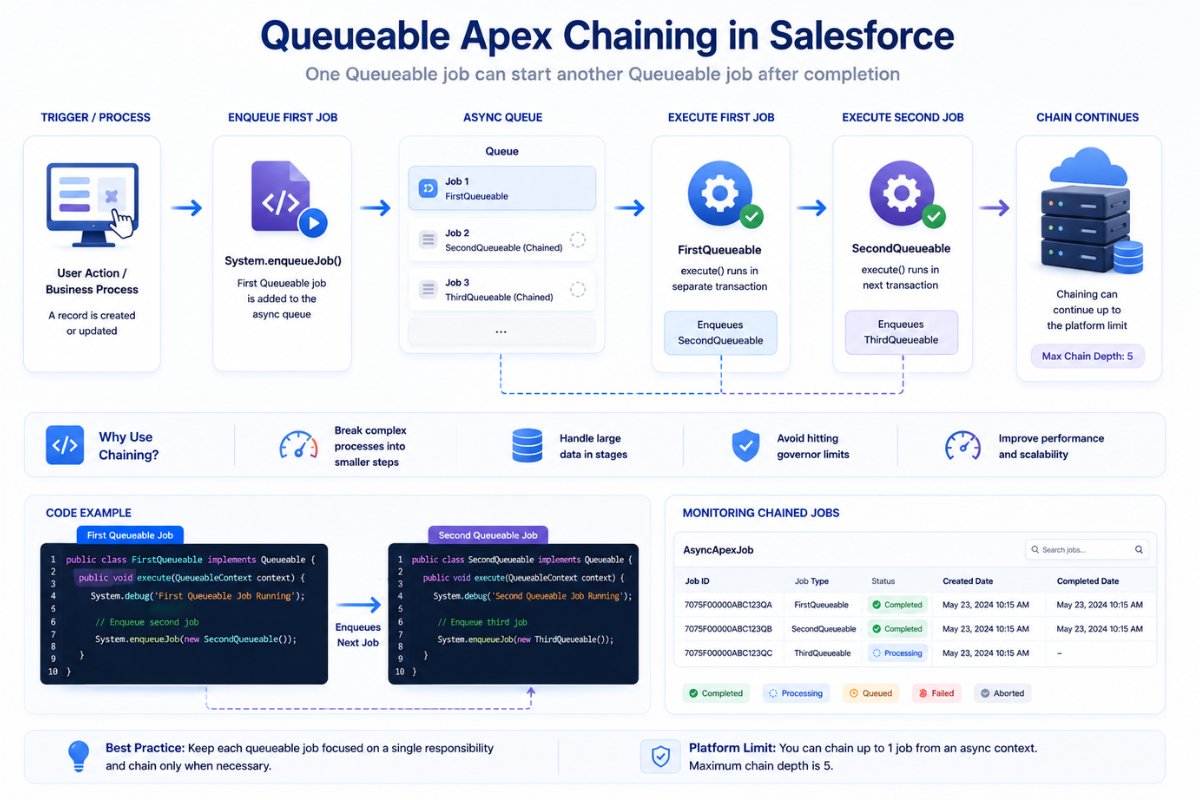
- Queueable Apex chaining workflow in Salesforce
- Batch Apex for Salesforce tutorial
- Salesforce REST API Tutorial for Beginners with Real Integration Examples
Atlas Reasoning Engine
The Atlas Reasoning Engine is the “brain” behind Agentforce.
This AI engine helps agents:
- Understand user intent
- Break tasks into steps
- Retrieve relevant data
- Decide what actions to execute
- Validate outputs
Instead of static workflows, Atlas enables dynamic AI decision-making.
For example:
A customer says:
“I want to upgrade my subscription and transfer licenses.”
The AI agent can:
- Retrieve customer records
- Verify subscription status
- Check license availability
- Create renewal opportunity
- Trigger billing workflows
- Update Salesforce records
All automatically.
Salesforce Data Cloud and Agentforce
Agentforce heavily depends on Salesforce Data Cloud.
Data Cloud helps agents access:
- Salesforce CRM data
- External system data
- Emails
- Documents
- Conversations
- Unstructured business information
This allows agents to generate more accurate responses.
Without proper data access, AI agents become less intelligent.

What Is RAG in Agentforce?
Salesforce Agentforce uses RAG (Retrieval-Augmented Generation).
RAG improves AI responses by retrieving real business data before generating answers.
Instead of relying only on AI model knowledge, Agentforce:
- Searches company data
- Retrieves relevant information
- Adds business context
- Generates more accurate responses
This improves:
- Accuracy
- Personalization
- Enterprise reliability
Agentforce Security and Trust Layer
One major concern with AI systems is security.
Salesforce solves this using the Einstein Trust Layer.
The Trust Layer helps:
- Protect sensitive data
- Apply security permissions
- Prevent unsafe outputs
- Monitor AI actions
- Maintain compliance
This is extremely important for enterprise AI adoption.
Organizations using healthcare, finance, or legal systems require strict AI governance.
Agentforce Use Cases
Salesforce Agentforce supports many real-world business use cases.
Customer Support Automation
AI agents can:
- Resolve support cases
- Retrieve customer information
- Answer FAQs
- Escalate complex cases
- Trigger workflows automatically
Sales Automation
Agentforce can:
- Qualify leads
- Create opportunities
- Generate personalized responses
- Recommend next actions
- Update pipeline records
Internal IT Support
AI agents can:
- Reset passwords
- Create tickets
- Handle approvals
- Answer employee questions
Marketing Automation
Agentforce can:
- Personalize campaigns
- Trigger journeys
- Recommend content
- Analyze customer engagement
Agentforce vs Traditional Chatbots
Many beginners confuse Agentforce with standard chatbots.
Here is the biggest difference:
| Feature | Traditional Chatbot | Salesforce Agentforce |
|---|---|---|
| Scripted responses | Yes | No |
| AI reasoning | Limited | Advanced |
| Workflow execution | Minimal | Full automation |
| CRM integration | Basic | Deep |
| API actions | Limited | Yes |
| Context awareness | Weak | Strong |
| Autonomous decisions | No | Yes |
Agentforce behaves more like an intelligent digital worker than a chatbot.
Agentforce vs Einstein Copilot
Salesforce also provides Einstein Copilot.
However, Agentforce and Copilot are different.
Einstein Copilot
- AI assistant for users
- Helps users complete tasks
- Requires human interaction
Agentforce
- Autonomous AI agents
- Executes actions independently
- Handles workflows automatically
Agentforce focuses more on autonomous AI automation.
Agentforce and Salesforce Developers
Developers play a major role in Agentforce implementations.
Developers may build:
- Custom Apex actions
- API integrations
- Prompt templates
- AI workflows
- Flow automations
- External system connectors
If you are preparing for AI-based Salesforce development, learning these topics becomes important:
- Apex Trigger Tutorial for Beginners in Salesforce
- Salesforce REST API Tutorial for Beginners with Real Integration Examples
- Queueable Apex chaining workflow in Salesforce
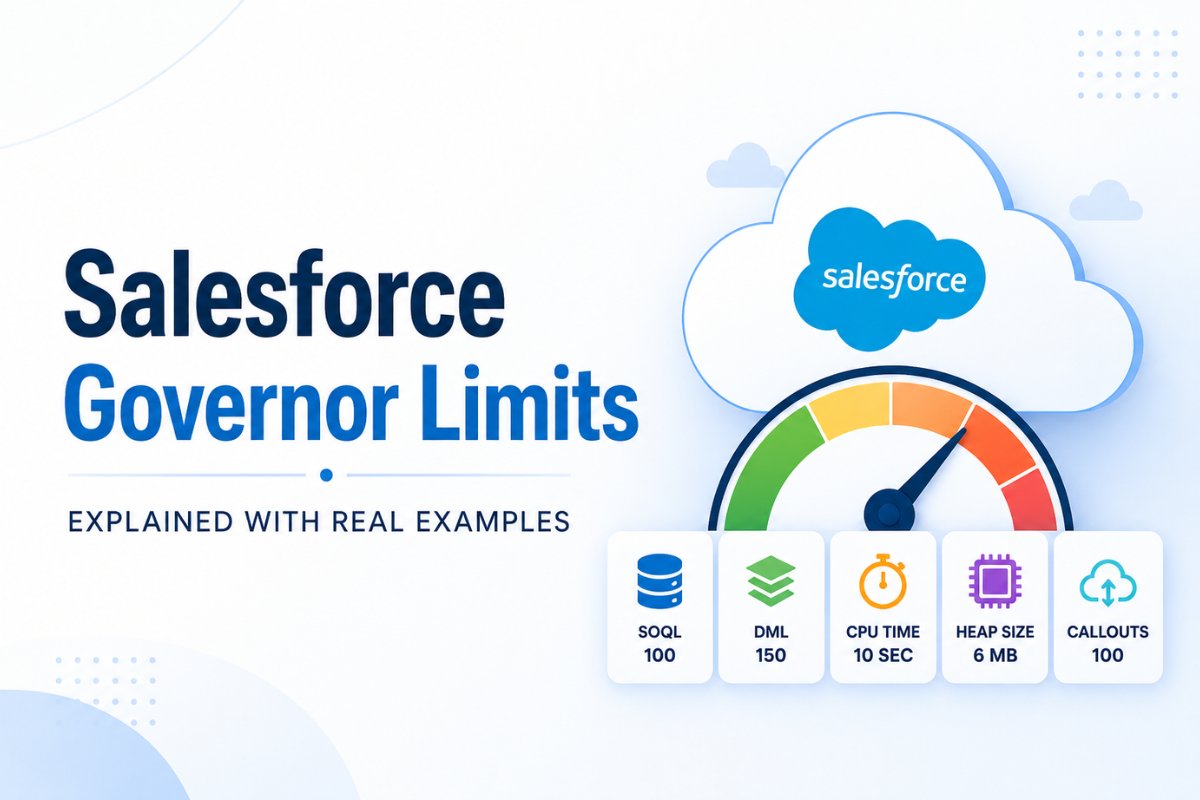
- Salesforce governor limits explained
How Agentforce Uses Flows and Apex
Agentforce does not replace Salesforce automation.
Instead, it works together with:
- Salesforce Flow
- Apex
- APIs
- Platform Events
- Data Cloud
For example:
AI agent receives request → Flow executes automation → Apex handles logic → API updates external system.
This hybrid architecture is extremely common in enterprise Salesforce projects.
Real-World Example of Agentforce
Imagine a telecom company using Agentforce.
Customer asks:
“My internet is slow and I want to upgrade my plan.”
The AI agent can:
- Retrieve customer account
- Check service history
- Identify current subscription
- Recommend better plan
- Create upgrade order
- Schedule technician
- Send confirmation email
All automatically without human intervention.
This dramatically improves efficiency and customer experience.

Benefits of Salesforce Agentforce
Businesses use Agentforce because it helps improve:
- Productivity
- Automation
- Customer experience
- AI-driven workflows
- Employee efficiency
- Response time
- Process scalability
It also reduces repetitive manual work for teams.
Challenges of Agentforce
Although powerful, Agentforce also introduces challenges.
Common challenges include:
- AI governance
- Data quality issues
- Complex integrations
- Prompt engineering
- Security management
- AI monitoring
- Cost management
Organizations must design AI systems carefully.
Best Practices for Agentforce
Follow these best practices while implementing Agentforce:
- Start with simple use cases
- Define strict AI guardrails
- Use high-quality business data
- Monitor AI outputs regularly
- Secure integrations carefully
- Use Flow and Apex efficiently
- Test AI workflows thoroughly
Future of Salesforce Agentforce
Salesforce is investing heavily in AI agents.
Agentforce will likely become deeply integrated into:
- Sales Cloud
- Service Cloud
- Marketing Cloud
- Commerce Cloud
- Slack
- Data Cloud
- CRM workflows
The future of Salesforce is clearly moving toward AI-driven autonomous systems.
This makes Agentforce one of the most important concepts for future Salesforce professionals.
Final Thoughts
Salesforce Agentforce represents a major shift from traditional CRM systems toward intelligent AI-powered automation.
Instead of using static workflows and basic chatbots, businesses can now create autonomous AI agents capable of reasoning, taking actions, retrieving data, and automating complex processes across Salesforce and external systems.
As Salesforce AI adoption continues growing, understanding Agentforce, Data Cloud, AI workflows, and intelligent automation will become an essential skill for Salesforce Admins, Developers, Architects, and Consultants.